When you search for a guided alpaca farm tour vs. a self-guided visit, you will find two very different experiences described as the same thing. One puts a knowledgeable guide beside you the whole time. The other leaves you to interpret the animals on your own.
Knowing what to expect on an alpaca farm tour can help you choose the experience that best fits your visit.
If you are not sure which format actually delivers, this guide breaks down both options clearly. It uses the real structure Alpaca Lane Criations follows in Upper Marlboro, Maryland.
A guided tour suits families, groups, and first-time visitors who want context and safe, hands-on access. A self-guided visit only works if no guide is available at all.
A Farm Visit Walkthrough: Quick Comparison
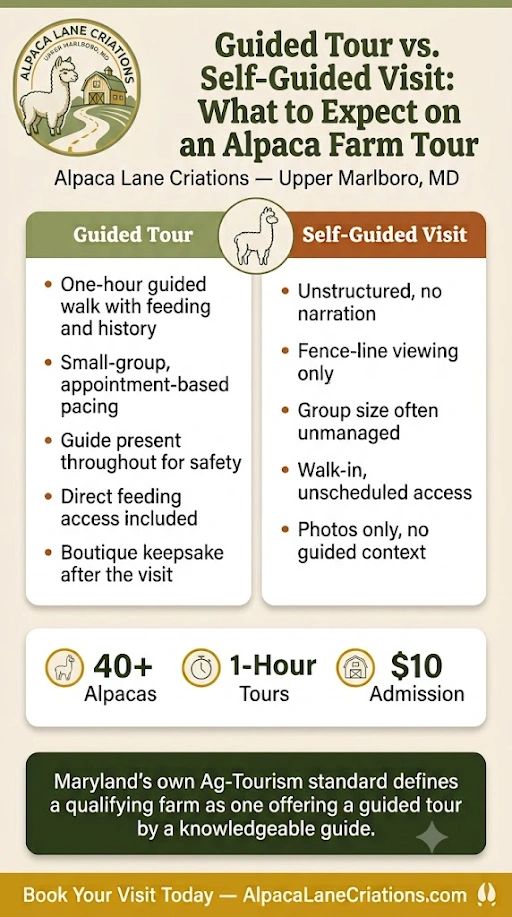
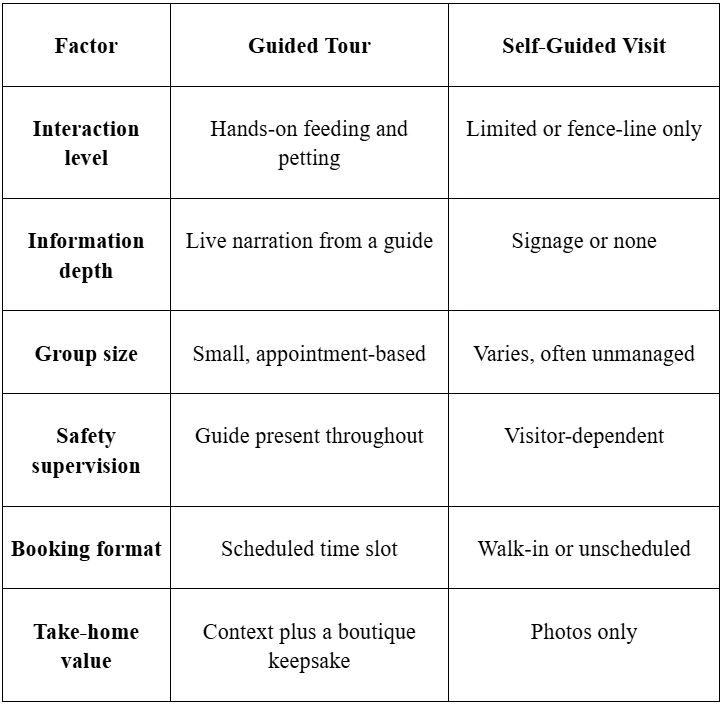
A guided alpaca farm tour and a self-guided farm visit differ most in supervision, information depth, and how much direct contact you actually get with the animals.
What Alpaca Lane Criations Does Best
Alpaca Lane Criations gives you direct, supervised contact with more than 40 alpacas across a one-hour visit, not a passive walk past a fence.
Your guide walks you through the herd for a full hour. That hour covers alpaca history, wool, and animal adaptations while you feed and pet the alpacas up close and personal. Admission includes grain for feeding, so the hands-on part of the visit starts within the first few minutes.
Every tour runs as a small, appointment-based group. That format is what lets you ask a question mid-visit and get a direct answer from someone who knows the herd by name, rather than reading a sign and guessing.
The farm sits on 20 working acres in Upper Marlboro, and the same owner who founded it in 2013 still leads most tours personally. That continuity matters, since a guide who built the herd from four alpacas to more than 40, questions answers from real, hands-on experience rather than a memorized script.
Grain is not something you have to request separately or pay extra for. It comes built into the admission price, so the feeding portion of the visit starts the moment your guide opens the gate, not after a side transaction slows the group down.
• One-hour guided walk that pairs feeding, petting, and history narration in a single continuous visit, so you never have to guess what happens next
• Small-group, appointment-based pacing that keeps every guest close enough to the guide to ask questions and get a direct answer, instead of competing for attention in a crowd
• Weekend scheduling at set times, which means you plan around a confirmed slot rather than hoping the farm is not crowded when you arrive
• Owner-led guidance on most visits, so the person answering your questions has direct, day-to-day experience with the herd rather than a rehearsed talking point
• Real visitor proof of that depth:
One recent guest wrote, “Sue takes so much pride in her Alpacas. We met the Alpacas and were given as much information as our hearts desired. My kids loved feeding and petting them, and the items in her shop were top quality.” (Nan Bronder, Website Review)
That level of detail is not something a self-guided format can offer. There is no one present to answer the question you did not know you had, and no one to point out which alpaca is safe to approach first.
What a Self-Guided Farm Visit Typically Offers
A self-guided farm visit means you walk the grounds without a guide narrating the experience. You rely on signage, if any, to explain what you are seeing.
Interaction with the animals usually stays limited to viewing from behind a fence line. No staff member manages feeding or direct contact in this format.
Group size often goes unmanaged, which can mean crowding at peak times with no one controlling the pace. Most self-guided visits also use informal or walk-in access instead of a scheduled slot.
This format can work for a quick, low-cost stop. It does not include the direct feeding access or narrated context a guided visit provides.
The Key Differences That Matter
The real gap between these two formats is not price. It is what you actually walk away understanding and touching.
Information Depth
Yes, a self-guided visit costs less staff time to run, but that saving usually means you leave without understanding alpaca behavior, wool use, or how to safely approach the herd, since no guide is there to explain it.
Why Guided Tours Are the Recognized Agritourism Standard in Maryland
According to the Maryland Manual, “354 Maryland farms supplemented their income through agritourism in 2022, including activities such as farm visits, farmers markets or farm stands, and county fairs.
Agritourism events across the state generate more than $162 million for the economy and support more than 1,000 jobs.
No competitor farm in the DMV region currently markets the guided-vs.-self-guided distinction as a reason to choose one format over the other, even though the state’s own definition treats guided access as the benchmark.
“According to the USDA Economic Research Service, U.S. farms and ranches generated $1.26 billion in agritourism income in 2022,” highlighting the growing economic role of on-farm experiences such as recreation, hospitality, and entertainment.
“The USDA Agritourism Resource Manual identifies guided, structured visitor programs as a core practice for agritourism operators building repeat visitation.”
That federal guidance lines up with what Alpaca Lane Criations already does every weekend.
Which Option Is Best for You?
Self-Guided Fits
Visitors who are comfortable navigating an unstructured animal encounter without narration, safety guidance, or a scheduled time slot, and who mainly want a quick photo stop rather than an educational visit.
Guided Fits
DMV families, couples, church groups, and scout troops who want expert-led, small-group access with full context on every interaction, plus a boutique keepsake to take home after the visit ends.
Frequently Asked Questions (FAQs)
Q1. What can I expect on a farm tour at Alpaca Lane Criations?
You get a one-hour guided visit where you feed and pet more than 40 alpacas. Admission includes grain, and a guide narrates alpaca history and care throughout. Tours run by appointment on weekends.
Q2. Is a guided alpaca farm tour better than a self-guided visit?
For most first-time visitors, yes. A guided tour gives you direct feeding access, safety supervision, and real-time answers, while a self-guided visit typically limits you to fence-line viewing with no narration.
Q3. Does Alpaca Lane Criations offer a self-guided option?
No. Every visit is a small-group, appointment-based guided tour, since that format is what allows guests to feed and interact with the alpacas safely.
Q4. How much does a guided alpaca farm tour cost?
Admission is $15 for adults age 13 and older and $8 for children ages 3 to 12. Children younger than three visit free, and admission includes grain for feeding.
Q5. Are guided alpaca tours safe for young children?
Yes. A staff member stays present throughout the visit, which lets young children feed and pet the alpacas under direct supervision instead of approaching them unsupervised.
Ready to Experience a Guided Alpaca Farm Tour
You now know what to expect on an alpaca farm tour, and the choice between guided and self-guided comes down to how much context and hands-on access you want.
A guided visit gives you both, along with a safe, small-group pace that a self-guided walk-through cannot match. Alpaca Lane Criations runs every tour this way, every weekend, by appointment.
Book your visit at Alpaca Lane Criations today and see the difference a knowledgeable guide makes.
